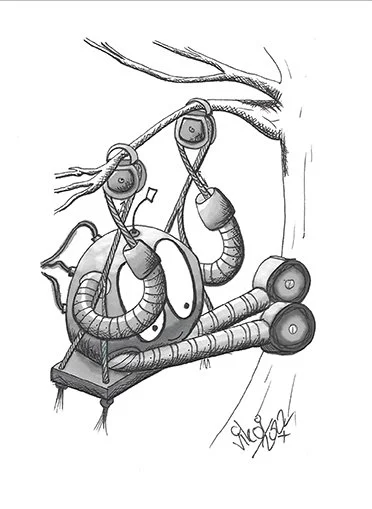
I’ve taken a bit of time out from blog writing and feeling any essence of creativity due to dealing with grief and it’s complications. However, I’m feeling back in the world of the living once more and what better way to make a come back, than a ‘How to’ series that no-one asked for.
So, how do you make a robot look like it has time? How do you make it look like nothing urgent is happening?
In my art and in general, when you see a robot it is doing something. Usually something important. Or at least something that looks important. They’re walking somewhere, scanning something, preparing for the next step. Even when they’re standing still, they look like they’ve been interrupted.
That’s the problem - a robot that looks busy doesn’t look like it has time. It looks like it’s about to apologise for not doing enough. To make a robot look like it has time, you have to remove the sense that it’s needed. This doesn’t mean it’s doing nothing demanding anything from it.
If this is your flex and you want to draw a robot that has time on it's hands, start with posture. Posture gives everything away. If the robot leans forward, it looks interested. Interest leads to intention. Intention leads to action. Action leads to urgency. We don’t need any of that. Let it stand normally. Or slightly awkwardly, like it shifted its weight once and never corrected it. Arms should rest where they naturally end up. Not posed. Not expressive.
If the robot is sitting, let it sit properly. No perching on the edge, no sense that it’s about to stand up again. This robot is not waiting for a cue.
Next, pay attention to what’s around it.
Busy surroundings make everything feel busy. Buttons, wires, screens and signs. These all suggest responsibility. Someone should be checking something. Possibly the robot. Give it space instead. A wall. A floor. Somewhere nothing much happens. Somewhere time can stretch out without being interrupted.
This robot is fine. It isn’t rushing.
You don’t need to give it an expression. Expressions invite interpretation. Interpretation leads to meaning. Meaning can get demanding.
If it has a head, angle it slightly away from whatever looks important in the scene. Not dramatically. Just enough to suggest that it’s already decided not to engage. If there is movement, slow it down. Or pause it halfway. A pause that lasts a bit too long is often more effective than motion. The robot knows time is passing. It just isn’t organised around it. Try not to turn this into a statement. Statements feel urgent. Messages want to be understood.
This isn’t about what the robot represents. It’s about how long it feels like it could stay exactly where it is.
If you’re interested in robots that aren’t in a hurry, there are more of them elsewhere on this site and www.instagram.com/vikoi1.
Some are standing.
Some are waiting.
None of them are rushing you.
You can take a look whenever you like.
.